Technology
A clinical-grade reading from a single drop of sweat.
BEA is a soft, skin-worn patch that samples sweat continuously and measures creatinine — a key marker of kidney function — in real time. Here's how it works, in plain terms.
The problem
Fifty years of the same blood test. Still only snapshots.
For more than fifty years, creatinine trends have been the standard of care for kidney function. Every data point costs a blood draw and a trip to the hospital, so doctors see a few dots a week and guess what happens in between.
“Logistical burden in the first 12 weeks, drive to the hospital at 5.30 AM.”
Rik Bouwmans-Booij, kidney transplant patient
Creatinine after discharge
Blood draws
With BEA
Day 10
first sign of decline
Day 8
first sign of decline
2 per week
data points
Continuous
trend, at home
Illustrative curve, not patient data.
Why sweat
99% water. The other 1% is a lab report.
Sweat is filtered from the blood, so it carries the same kind of signals a blood test looks for. And unlike blood, you can collect it all day without a needle.
1%
metabolic markers
Electrolytes
+
The salts that keep fluid balance and nerves in check.
Metabolic markers
BEA's first target
+
Waste and fuel the body processes. Creatinine is the one nephrologists have trusted for decades, and the one BEA reads first.
Stress signals
+
Hormones that rise and fall with physical and mental load.
Inflammation & signalling
+
Messenger molecules of the immune and endocrine system.
Foreign substances
+
What enters the body from outside, medication included.
How BEA works
Moving sweat one nanolitre at a time.
A patient lying in a hospital bed or on the couch barely sweats. BEA was built for exactly that: it catches tiny amounts and moves them with electricity instead of pumps.
Step 1 of 4
Droplets counted
0
01 · Collect
Sweat, at rest.
The chip sits on the skin and picks up sweat right where it leaves the gland, even at the trickle a resting patient produces.
02 · Pinch off
One droplet at a time.
The sweat is cut into separate droplets of about one nanolitre each, smaller than a grain of salt.
≈ 1 nL
per droplet
03 · Transport
Moved by electricity, not pumps.
A grid of electrodes switches on one after another at very low voltage, and the droplet follows. This is called electrowetting. Counting the droplets gives the sweat rate for free.
0 pumps
no moving parts on the skin
04 · Measure & send
From droplet to trend.
At the sensor, creatinine is measured. The reusable BEA Bay sends the reading over Bluetooth, and the software turns readings into a trend the care team sees in the patient record.
The first sweat-based
kidney monitor
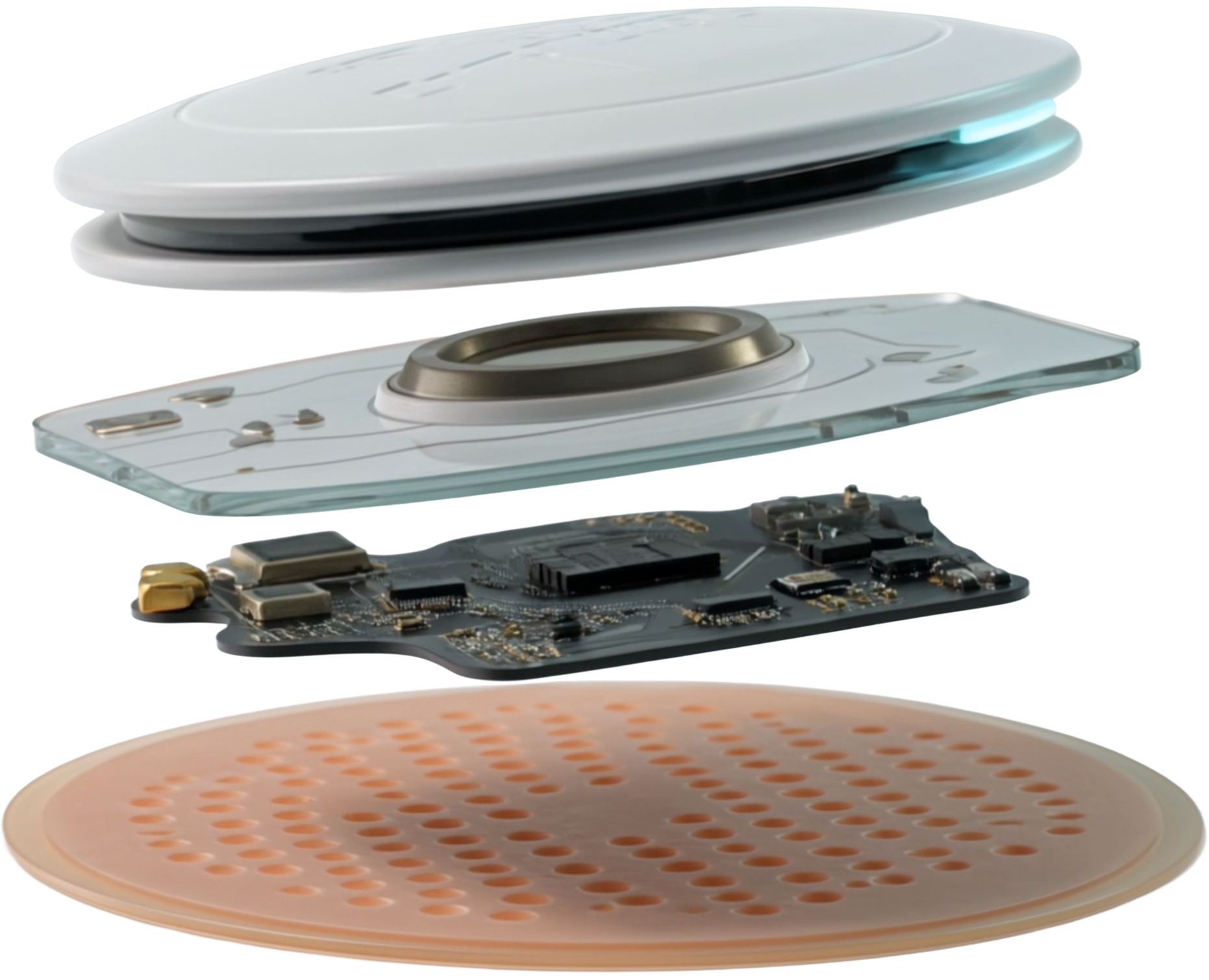
Meet BEA. A patented discretised-microfluidics platform that turns a single droplet of sweat into a continuous clinical signal.
bea chip
Biosensor Core
The disposable microfluidic chip at the heart of BEA. Uses patented EWOD technology to transport individual sweat droplets, down to 1 nL, directly onto the creatinine sensor array.
What changes for the patient
After discharge, recovery stays at home.
Today
With BEA
1
Travel to hospital
A trip for every check-up, sometimes before sunrise.
Recover at home
No trips to the hospital for routine checks.
2
Blood draw
Samples go to the hospital lab for analysis.
Wear BEA
The patch measures the creatinine trend.
Detects early changes
3
Outpatient visit
Results are discussed and medication adjusted.
Late & reactive
(e-)Nurse watches the trend
And alerts the nephrologist when needed.
4
Rehospitalisation
When deterioration is spotted too late.
E-consult
Results discussed and medication adjusted, remotely.
What it saves
Fewer blood draws
Fewer outpatient visits
Fewer acute hospitalisations
Shorter hospital stays
Fewer kidney biopsies
Less travel, less CO₂
Built on research
Born at TU/e. Published, patented, funded.
1st
wearable with integrated electrowetting that collects and moves sweat on the body, published in 2024.
3
patents protecting the core technology.
€185k
NWO Faculty of Impact funding.
2026
first patient studies planned, on the way to CE marking.